March 1, 2016
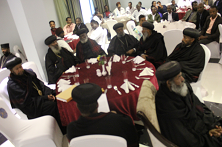
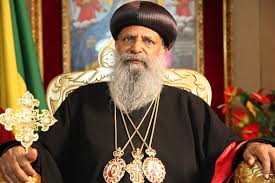
Pope Francis urged world leaders to “promote peaceful coexistence” in the face of “a devastating outbreak of violence against Christians” on Monday, when he received the Patriarch of the Ethiopian Orthodox Tewahedo Church, Abune Matthias I, in the Vatican.
The Ethiopian Orthodox Tewahedo Church is the largest of the Oriental Orthodox Churches, which rejected the definitions of the Council of Chalcedon in AD 451.
In his address, Pope Francis told Pope Matthias I “what unites us is greater than what divides us,” and added that “shared sufferings have enabled Christians, otherwise divided in so many ways, to grow closer to one another.”
“Just as in the early Church the shedding of the blood of martyrs became the seed of new Christians, so today the blood of the many martyrs of all the Churches has become the seed of Christian unity,”
Pope Francis said. “The ecumenism of the martyrs is a summons to us, here and now, to advance on the path to ever greater unity.” Pope Francis noted that “from the beginning” the Ethiopian Church has been a Church of martyrs.
“Today too, you are witnessing a devastating outbreak of violence against Christians and other minorities in the Middle East and in some parts of Africa,” Pope Francis said. “We cannot fail, yet again, to implore those who govern the world’s political and economic life to promote a peaceful coexistence based on reciprocal respect and reconciliation, mutual forgiveness and solidarity.”
Abune Mathias was scheduled to visit the tomb of St Peter, hold talks at the Pontifical Council for Promoting Christian Unity and celebrate the Divine Liturgy with members of the large Ethiopian community in the chapel of Rome’s ‘Urbanianum’ College.
According to historical records of the Ethiopian Orthodox Church, Christianity in Ethiopia dates to the 1st century AD as it recorded in the New Testament (Acts 8:26-38) when Philip the Evangelist converted an Ethiopian court official. Latter, Orthodox Christianity became the established church of the Ethiopian Axumit Kingdom under king Ezana in the 4th century when priesthood and the sacraments were brought for the first time through a Syrian Greek named Frumentius, known by the local population in Ethiopia as Abba Selama, Kesate Birhan ("Father of Peace, Revealer of Light"). Abba Selama was ordained as bishop in Egypt by St Athenasius of Alexandria and returned to Ethiopia to spread the Christian faith. The Church has maintained a number of ancient Jewish traditions, including the practice of circumcision, dietary restrictions and the observance of the Sabbath day.
According to the Parish Council Department of the Patriarchate, the Church counts some 50 million members and until very recently maintained the use of the ancient Ge’ez language for the liturgy, although many parishes now prefer to use Amharic, the main language of modern day Ethiopia.
The Orthodox Church is part of the International Mixed Commission for Theological Dialogue with the Catholic Church which meets annually, alternating between Rome and one of the countries represented by the seven Orthodox members. Relations with the Catholic Church were significantly strengthened under the previous Patriarch, Abuna Paulos, who met with Pope John Paul II ion 1993, with Pope Benedict in 2009 and in that same year, also addressed the special Synod of Bishops for Africa as an ecumenical guest. In January 2012 the members of the Mixed Commission were warmly welcomed to Addis Abeba by Abuna Paulos, who died suddenly later in the year.
Abuna Mathias, who lived in exile for three decades during the communist dictatorship of Mengistu Haile Mariam, was elected as head of the Church three years ago, on February 28th, 2013.
The full address by Pope Francis is below
Address of His Holiness Pope Francis
To His Holiness Pope Matthias I
Patriarch of the Ethiopian Orthodox Tewahedo Church
Monday, 29 February 2016
Your Holiness,
Dear Brothers and Sisters in Christ,
It is a joy and a moment of grace to be able to welcome all of you here present. I greet with affection His Holiness and the distinguished members of the Delegation. I thank you for your words of friendship and spiritual closenesss. Through you, I send cordial greetings to the bishops, clergy and the entire family of the Ethiopian Orthodox Tewahedo Church throughout the world. The grace and peace of our Lord Jesus Christ be with you all.
Your Holiness’s visit strengthens the fraternal bonds already uniting our Churches. We recall with gratitude the visit of Patriarch Abuna Paulos to Saint John Paul II in 1993. On 26 June 2009, Abuna Paulos returned to meet Benedict XVI, who invited him to return in October of that same year as a special guest, to address the second Assembly for Africa of the Synod of Bishops on the situation in Africa and the challenges facing its peoples. In the early Church, it was common practice that one Church would send representatives to the synods of other Churches. This sense of ecclesial sharing was evident also in 2012, on the occasion of the funeral of His Holiness Abuna Paulos, at which a delegation of the Holy See was present.
From 2004 on, the Catholic Church and the Eastern Orthodox Churches have worked together to deepen their communion through the theological dialogue advanced by the Joint International Commission. We are happy to note the increasing participation of the Ethiopian Orthodox Tewahedo Church in this dialogue. Over the years, the Commission has examined the fundamental concept of the Church as communion, understood as participation in the communion between the Father, the Son and the Holy Spirit. In this way, we have come to see that we have almost everything in common: one faith, one Baptism, one Lord and Saviour, Jesus Christ. We are united by virtue of our Baptism, which has made us members of the one Body of Christ. We are also united by the various common elements of our rich monastic traditions and liturgical practices. We are brothers and sisters in Christ. As has often been observed, what unites us is greater than what divides us.
We truly feel that the words of the Apostle Paul apply to us: “If one member suffers, all suffer together; if one member is honoured, all rejoice together” (1 Cor 12:26). Shared sufferings have enabled Christians, otherwise divided in so many ways, to grow closer to one another. Just as in the early Church the shedding of the blood of martyrs became the seed of new Christians, so today the blood of the many martyrs of all the Churches has become the seed of Christian unity. The martyrs and saints of all the ecclesial traditions are already one in Christ. Their names are inscribed in the one martyrologium of the Church of God. The ecumenism of the martyrs is a summons to us, here and now, to advance on the path to ever greater unity.
From the beginning, yours has been a Church of martyrs. Today too, you are witnessing a devastating outbreak of violence against Christians and other minorities in the Middle East and in some parts of Africa. We cannot fail, yet again, to implore those who govern the world’s political and economic life to promote a peaceful coexistence based on reciprocal respect and reconciliation, mutual forgiveness and solidarity.
Your country is making great strides to improve the living conditions of its people and to build an ever more just society, based on the rule of law and respect for the role of women. I think in particular of the problem of access to water, with its grave social and economic repercussions. There is great room for cooperation between the Churches in the service of the common good and the protection of creation. I am certain of the readiness of the Catholic Church in Ethiopia to work together with the Orthodox Tewahedo Church over which Your Holiness presides.
Your Holiness, dear brothers and sisters, it is my fervent hope that this meeting will mark a new chapter of fraternal friendship between our Churches. We are conscious that history has left us with a burden of painful misunderstandings and mistrust, and for this we seek God’s pardon and healing. Let us pray for one another, invoking the protection of the martyrs and saints upon all the faithful entrusted to our pastoral care. May the Holy Spirit continue to enlighten us and guide our steps towards harmony and peace. May he nourish in us the hope that one day, with God’s help, we will be united around the altar of Christ’s sacrifice in the fullness of Eucharistic communion. I pray to Mary, Mother of Mercy, for each of you, with words drawn from your own beautiful and rich liturgical tradition: “O Virgin, wellspring of the fountain of wisdom, bathe me in the streams of the Gospel of Christ your Son. Defend me by his Cross. Cover me with his mercy, gird me with his clemency, renew me with his unction and surround me with his fruits. Amen”.
Your Holiness, may Almighty God abundantly bless your ministry in the service of the beloved people of the Ethiopian Orthodox Tewahedo Church.
Source: Vatican Radio (with some modifications)
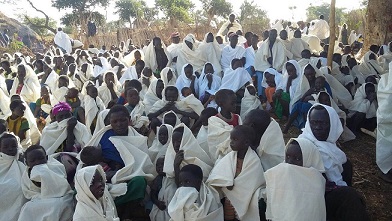
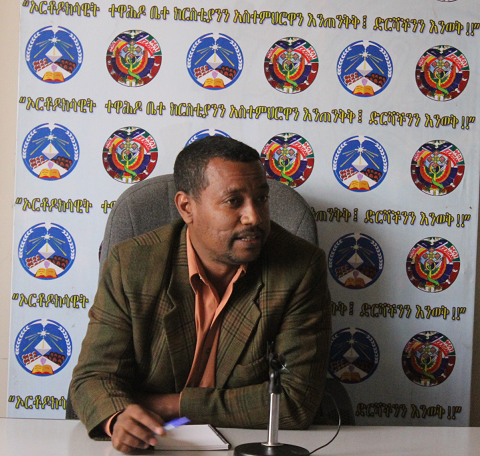 General Secretary of the association, Ato Tesfaye Bihonegn explained the steps went through and the activities carried out in organizing the exhibition. According to Ato Tesfaye, Mahiber Kidusan has reached agreement with the exhibition center to stage a one week exhibition a year before, August 2015. He also added that, they have fulfilled all the required criteria. First, a letter of endorsement giving the go-ahead and written by the general manager of the Patriarchate of Archbishop Abune Mathewos was submitted to the company followed by the signing of an agreement with the company and handing over of the initial payment.
 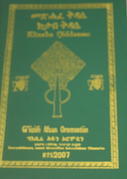 The Book Liturgy of the Ethiopian Orthodo0x Tewahido Church has been translated into Oromoiffa. The inauguration ceremony of the newly published Book of Liturgy was held last week on March 19, 2016, at Elili International Hotel, Addis Ababa
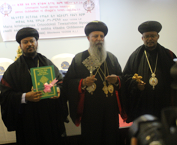 His Holiness Abune Mathias, Archbishops, former Ethiopian President Girma Wolde-Giorgis, officials of the Oromia region, administrators and staff members of Addis Ababa Diocese, Oromifa speaking intellectuals and believers attended the inauguration ceremony.